
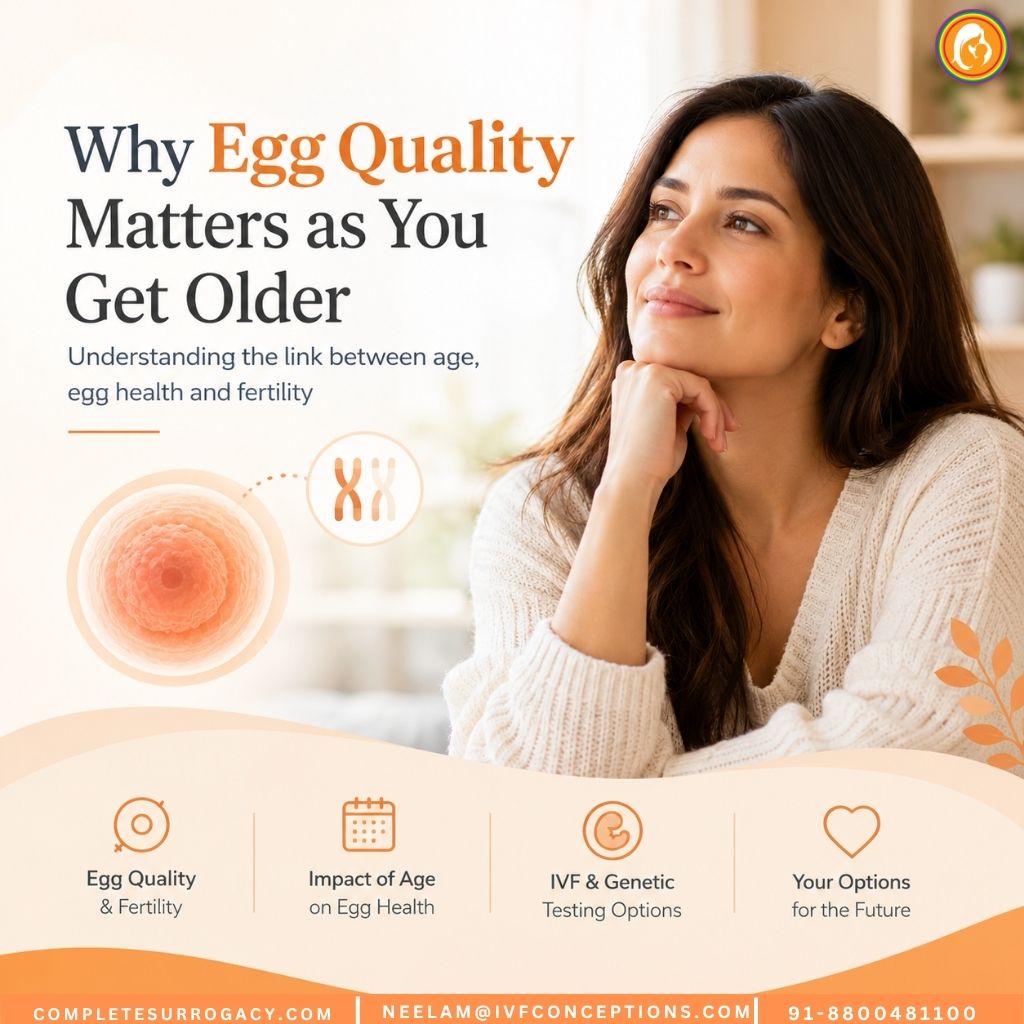
Egg quality plays an important role in fertility and conception. In fertility medicine, egg quality generally refers to the likelihood that an egg has the correct number of chromosomes and can support normal fertilization and embryo development.
As women age, eggs become more likely to undergo errors in chromosome separation during meiosis. These changes can increase the chance of embryos with an abnormal number of chromosomes, which may affect fertilization, implantation, embryo development, and pregnancy.
This is why egg quality matters as you get older. While a healthy lifestyle can support overall reproductive health, there is currently no established treatment that can reliably reverse age-related chromosome abnormalities in an individual egg.
📞 Get in Touch for a Free Surrogacy Consultation
📱 +91-8800481100 (WhatsApp | LINE | Viber)
📧 neelam@ivfconceptions.com
Key Takeaways
- Egg quality refers to the reproductive potential and chromosomal health of an egg.
- The likelihood of chromosome abnormalities in eggs generally increases with age.
- Egg count and egg quality are different aspects of ovarian function.
- There is no routine test that can directly determine the chromosome status of every egg before fertilization.
- IVF can provide information about embryo development and, when appropriate, embryo genetic testing can assess chromosome numbers.
- Egg freezing may allow some women to preserve eggs at a younger age for possible future use.
- Donor eggs may be considered when age-related changes in egg quality make it difficult to create viable embryos using one’s own eggs.
More Resources to read:
How Age Affects Fertility and Success Rate
IVF with egg donor success rates
What to consider after IVF failure
Why Egg Quality Matters as You Get Older: Understanding Aging and Egg Quality
Eggs begin developing in the ovaries before birth and remain there in an immature state until they are recruited during the reproductive years. Before ovulation, the selected egg goes through stages of cell division called meiosis to prepare for possible fertilization.
As women age, the mechanisms responsible for accurate chromosome separation during meiosis may become less reliable. This increases the likelihood that an egg will contain too many or too few chromosomes.
This age-related change helps explain the connection between egg quality and conception. A higher proportion of chromosomally abnormal eggs can reduce the likelihood of creating an embryo capable of normal development.
What egg quality means for fertility and conception
Egg quality describes factors that influence whether an egg can be successfully fertilized and contribute to normal embryo development.
A chromosomally normal embryo is described as euploid, while an embryo with an abnormal number of chromosomes is described as aneuploid. Aneuploid embryos may fail to implant, stop developing, or result in miscarriage. Some chromosome abnormalities can also result in pregnancies affected by genetic conditions.
Egg quality is therefore different from simply having a sufficient number of eggs. A person may have a reasonable ovarian reserve while still experiencing age-related changes in the proportion of eggs that are chromosomally normal.
How aging can affect egg chromosomes
During meiosis, chromosomes must be distributed accurately as an egg matures. With increasing age, errors in this process become more common. An egg may consequently contain an abnormal number of chromosomes.
There is no routine clinical test that can directly determine the chromosome status of every egg in the ovaries before fertilization. In IVF, genetic testing such as preimplantation genetic testing for aneuploidy (PGT-A) can assess chromosome numbers in embryos, but it does not directly test the quality of every egg.
Age provides fertility specialists with an important indication of the likelihood of chromosomal abnormalities. However, it cannot predict the result for one individual egg or guarantee the outcome of a fertility treatment.
Why egg count and egg quality are different
Egg count refers to the estimated number of eggs remaining in the ovaries, often described as ovarian reserve. Egg quality refers to the likelihood that an egg can support fertilization and normal embryo development.
A higher egg count does not necessarily mean that the eggs are younger or more likely to be chromosomally normal. Likewise, a lower ovarian reserve does not automatically mean that pregnancy is impossible.
Fertility testing may include hormone tests such as AMH, ultrasound assessment of antral follicle count, and other clinical evaluations. These tests can provide information about ovarian reserve, but they do not directly measure the chromosomal health of individual eggs.
| Term | Meaning | Why It Matters |
|---|---|---|
| Primordial egg | An immature egg present in the ovary | It may develop toward ovulation during the reproductive years |
| Meiosis | A form of cell division involved in egg maturation | Chromosome separation errors can occur during this process |
| Euploid | An embryo with the expected number of chromosomes | It generally has a greater potential for normal development |
| Aneuploid | An embryo with an abnormal number of chromosomes | It may fail to implant, stop developing, or result in miscarriage |
| Egg count | An estimate of the remaining ovarian reserve | It does not directly indicate the chromosome status of individual eggs |
Reference: ASRM – Testing and Interpreting Measures of Ovarian Reserve
Aging and Reproductive Health: Egg Quality, Fertility Treatment, and Family Planning
Age is one of the most important factors affecting female reproductive potential. As age increases, the proportion of eggs with chromosomal abnormalities generally rises. This can make conception more difficult and increase the likelihood of miscarriage.
However, fertility and reproductive health involve more than egg quality alone. Ovarian reserve, sperm quality, the uterus, overall health, medical history, and other factors can also influence fertility and pregnancy outcomes.

How age-related fertility issues can affect pregnancy outcomes
In most menstrual cycles, one egg is released during ovulation. As the proportion of chromosomally abnormal eggs increases with age, the likelihood that the ovulated egg will have a chromosome abnormality also increases.
If an abnormal egg is fertilized, the resulting embryo may not implant or may stop developing. Some chromosomal abnormalities can also result in miscarriage or a pregnancy affected by a genetic condition.
A fertility specialist can review age, medical history, ovarian reserve, previous pregnancies or fertility treatments, and reproductive goals to help determine appropriate next steps.
What IVF can reveal about egg age
In vitro fertilization (IVF) can help illustrate how age affects reproductive outcomes, particularly when comparing treatment using a patient’s own eggs with treatment using donor eggs.
When a patient uses their own eggs, IVF success rates generally decline with increasing age. One important reason is the higher proportion of eggs that may have chromosomal abnormalities.
Donor-egg IVF can show a different pattern because the eggs come from a younger donor. The recipient’s age may still affect pregnancy and obstetric considerations, but egg age itself is less of a limiting factor.
Fertility clinics may use blood tests, ultrasound, medical history, and previous treatment outcomes to help guide treatment planning. Individual results vary, and no fertility treatment can guarantee a pregnancy.
Reference: ASRM – Fertility Evaluation of Infertile Women
Options for preserving younger eggs
Egg freezing, also called oocyte cryopreservation, allows eggs to be collected and stored for possible future use. When eggs are frozen at a younger age, they may have a lower expected rate of age-related chromosomal abnormalities.
However, egg freezing does not guarantee a future pregnancy. Outcomes depend on factors such as age at freezing, the number of mature eggs stored, the freezing and thawing process, fertilization, embryo development, and other reproductive factors.
For people considering fertility preservation, discussing the timing and realistic expectations with a reproductive medicine specialist can be helpful.
| Factor | What it may show | Why it matters |
|---|---|---|
| Egg age | The chance of chromosome changes | Older eggs have a greater risk of reduced fertilization and miscarriage |
| Egg count | The remaining ovarian reserve | A higher count does not confirm strong egg quality |
| Own-egg IVF | Success linked to the patient’s age | Pregnancy rates tend to decline as egg age rises |
| Donor-egg IVF | Eggs from a younger donor | Pregnancy rates remained near 51 percent across age groups |
| Egg freezing | Storage of eggs for later use | It supports preserving egg quality before further age-related change |
When Egg Quality Affects Family-Building Options
Age-related changes in egg quality can sometimes make it difficult to create viable embryos using a person’s own eggs. Depending on the circumstances, a fertility specialist may discuss options such as additional IVF treatment, fertility preservation, donor eggs, or other family-building approaches.
For people who also cannot safely carry a pregnancy, gestational surrogacy may be another option to consider. Surrogacy decisions involve medical, legal, financial, and personal considerations, and the appropriate pathway varies from person to person.
A fertility specialist and qualified legal professionals can help intended parents understand the options that may be available based on their individual circumstances.
More Resources to read:
Understanding the Surrogacy Process
International Surrogacy Timeline
Conclusion
Egg quality plays an important role in fertility as women get older. One of the main age-related changes is an increasing likelihood of chromosome abnormalities during egg maturation. These abnormalities can affect fertilization, embryo development, implantation, and pregnancy.
Egg quality and egg count are not the same. Tests for ovarian reserve can provide information about the estimated number of eggs remaining, but they cannot directly determine the chromosome status of individual eggs.
IVF can provide additional information about fertilization and embryo development, while appropriate embryo testing can assess chromosome numbers. For some patients, egg freezing may provide an opportunity to preserve eggs at a younger age for possible future use.
When age-related changes make it difficult to achieve a viable pregnancy using one’s own eggs, treatment options may include donor eggs or other family-building pathways. For individuals who cannot safely carry a pregnancy, gestational surrogacy may also be considered.
Because fertility varies considerably between individuals, a reproductive medicine specialist can help explain how age, ovarian reserve, egg quality, medical history, and reproductive goals may affect available options.
FAQ for Egg Quality as you get older
Why does egg quality matter as you get older?
Egg quality is important because an egg must be capable of successful fertilization and contribute to normal embryo development. As women age, eggs become more likely to have chromosome abnormalities, which can reduce the likelihood of a successful pregnancy and increase the risk of miscarriage.
How does aging affect egg quality?
As age increases, errors in chromosome separation during meiosis become more common. This can result in eggs with too many or too few chromosomes. The proportion of chromosomally abnormal eggs generally increases with age.
What is the difference between egg quality and ovarian reserve?
Ovarian reserve refers to the estimated number of eggs remaining in the ovaries. Egg quality refers to factors that influence an egg’s ability to support fertilization and normal embryo development. Tests such as AMH and antral follicle count provide information about ovarian reserve but do not directly measure the chromosomal health of individual eggs.
Can egg quality be tested directly?
There is no routine clinical test that can directly determine the chromosome status of every egg before fertilization. During IVF, embryos can sometimes undergo genetic testing such as PGT-A to assess chromosome numbers. This evaluates embryos rather than directly testing every egg in the ovaries.
How can egg quality affect conception and pregnancy?
An egg with the appropriate chromosome number has a greater potential to contribute to normal embryo development. An egg with chromosome abnormalities may result in an embryo that fails to implant, stops developing, or results in miscarriage. Some chromosome abnormalities can also lead to a pregnancy affected by a genetic condition.
Why does female fertility decline with age?
Female fertility declines with age for several reasons. One major factor is the increasing proportion of eggs with chromosome abnormalities. Ovarian reserve also decreases over time, although the rate varies between individuals. Changes in the reproductive system and other health factors can also influence fertility.
What does age mean for pregnancy after 35?
Age can affect both fertility and pregnancy outcomes. As maternal age increases, the likelihood of age-related changes in egg chromosomes rises, and the risks of miscarriage and certain pregnancy complications also increase. Individual risk depends on overall health, medical history, and other factors.
Can egg freezing preserve egg quality?
Egg freezing can preserve eggs at the age when they are collected. It does not reverse age-related changes in eggs that have already occurred. Freezing eggs at a younger age may preserve eggs with a lower expected rate of age-related chromosome abnormalities, but it does not guarantee a future pregnancy.
Can lifestyle changes restore egg quality?
A healthy lifestyle can support general reproductive and overall health, but there is currently no proven lifestyle intervention that can reverse age-related chromosome abnormalities in individual eggs. Factors such as nutrition, smoking, alcohol use, exercise, and general health can still be relevant to reproductive care.
When might donor eggs be considered?
Donor eggs may be considered when age-related changes in egg quality or other fertility factors make it difficult to achieve a viable pregnancy using one’s own eggs. The decision depends on individual medical circumstances, reproductive goals, and personal preferences and should be discussed with a fertility specialist.
How does ovarian reserve relate to reproductive health and aging?
Ovarian reserve provides an estimate of the remaining egg supply. It is useful when planning fertility treatment, but it does not directly measure egg quality. Age remains an important factor when assessing the likelihood of chromosomal abnormalities in eggs.

Author Bio: Neelam Chhagani is an International Surrogacy Expert with 15 years of experience in the fertility and surrogacy domain. As the founder of IVF Conceptions and Complete Surrogacy, she has guided over 4,000 intended parents worldwide on their surrogacy journey to parenthood. Recognized as a trusted authority, she specializes in holistic infertility solutions and third-party reproduction consulting.
Holding an MA in Counselling Psychology and a PGD in Mental Health, Neelam is a proud member of the European Fertility Society (EFS) and the European Society of Human Reproduction and Embryology (ESHRE). She is also a leading surrogacy blogger, providing valuable insights into ethical and practical surrogacy solutions.
Since 2010, committed to supporting ALL family types, Neelam has been passionate about helping intended parents grow their families with compassion, integrity, and a focus on secure and affordable surrogacy options Globally.
Learn more about Neelam:
https://www.ivfconceptions.com/neelam-chhagani-surrogacy-consultant/
https://www.linkedin.com/in/neelam-chhagani-92892229/












I was introduced to Neelam by a friend who worked with Neelam for surrogacy. Neelam is absolutely wonderful. I am a single male and the journey to fatherhood is not that easy. Neelam connected me to a program ideal for my circumstances. She was with me throughout the pregnancy providing advice and guidance along the way. I am so grateful I found her and am thrilled today that I have a beautiful daughter. I highly recommend Neelam to anyone who is on a journey to become a parent. Having a child has changed my world for the better. I wish others success with their own journey and recommend you connect with Neelam to find a path that is best for you.
SA (USA)