
Understanding how thyroid health affects fertility in men & women is crucial because thyroid hormones play a central role in regulating metabolism, ovulation, sperm production, and overall reproductive balance. In women, untreated hypothyroidism or hyperthyroidism can disrupt menstrual cycles, impair ovulation, increase miscarriage risk, and reduce IVF success rates, while proper treatment often restores fertility outcomes.
In men, thyroid disorders may affect sperm count, motility, and testosterone levels, leading to reduced conception potential. Since thyroid imbalances are common and easily diagnosed through blood tests, early screening and medical management can significantly improve natural fertility as well as success with IVF or surrogacy.
Key Takeaways
- Thyroid hormones (T3, T4) and TSH regulate metabolism and directly influence reproductive tissues.
- Pregnancy alters thyroid physiology—hCG, estradiol, and gland size changes affect testing and management.
- Receptors for thyroid hormones exist in ovaries, endometrium, and male reproductive tissue, linking thyroid function and fertility.
- Normal thyroid health supports regular cycles, ovulation, implantation, and sperm production.
- If you are planning pregnancy or surrogacy, early thyroid testing and coordination with your clinician improve outcomes.
📞 Get in Touch for a Free Surrogacy Consultation
📱 +91-8800481100 (WhatsApp | LINE | Viber)
📧 neelam@ivfconceptions.com
Thyroid Disorders and Their Impact on Female Fertility and Pregnancy Outcomes
Thyroid disorders can affect fertility in many ways. This includes overt disease, mild thyroid dysfunction, and autoimmune processes. Each can impact menstrual cycles, ovulation, and pregnancy risks.
Hypothyroidism and subclinical hypothyroidism
Overt hypothyroidism and subclinical hypothyroidism have different effects on fertility. Both can cause menstrual irregularities and high prolactin levels. This can make it hard to ovulate.
High TSH levels are linked to lower ovarian reserve. This means higher FSH and lower antral follicle count. Studies suggest early detection is key for unexplained infertility.
Research on ART shows mixed results. Some studies suggest TSH ≤2.5 mIU/L for better IVF outcomes. Larger studies find no clear difference in live birth rates. Guidelines recommend adjusting levothyroxine before conception and during early pregnancy.
Hyperthyroidism and thyrotoxicosis
Graves’ disease is the main cause of hyperthyroidism in young women. Gestational transient thyrotoxicosis from hCG is common in the first trimester.
Hyperthyroidism can disrupt menstrual cycles and sex hormone levels. This can lower chances of getting pregnant naturally. Managing active thyrotoxicosis before ART is crucial for safety.
Uncontrolled hyperthyroidism increases risk of miscarriage and preterm birth. It also raises the risk of maternal cardiac complications. Antithyroid drugs are used at the lowest effective dose during pregnancy. Propylthiouracil is preferred in the first trimester.
Thyroid autoimmunity (TAI) and unexplained infertility
Thyroid autoimmunity can affect fertility even when thyroid function is normal. Positive TPO or thyroglobulin antibodies may indicate immune activation or direct ovarian effect.
Meta-analyses show TAI is linked to higher miscarriage risk in IVF. Some studies suggest possible reductions in live births. Results are mixed, so individualized assessment is crucial.
Treatment trials have not shown clear benefits of levothyroxine for women with positive antibodies. More evidence is needed for antioxidants or immunomodulation.
Screening for TSH and TPO antibodies during fertility evaluation is important. It helps identify treatable causes. Clinicians must balance guidelines and patient goals when addressing these issues.
Thyroid Function and Male Fertility
Thyroid hormones are key for male reproductive health. They work with testicular tissue and affect hormone balance. This is important for men trying to get pregnant or donating sperm.
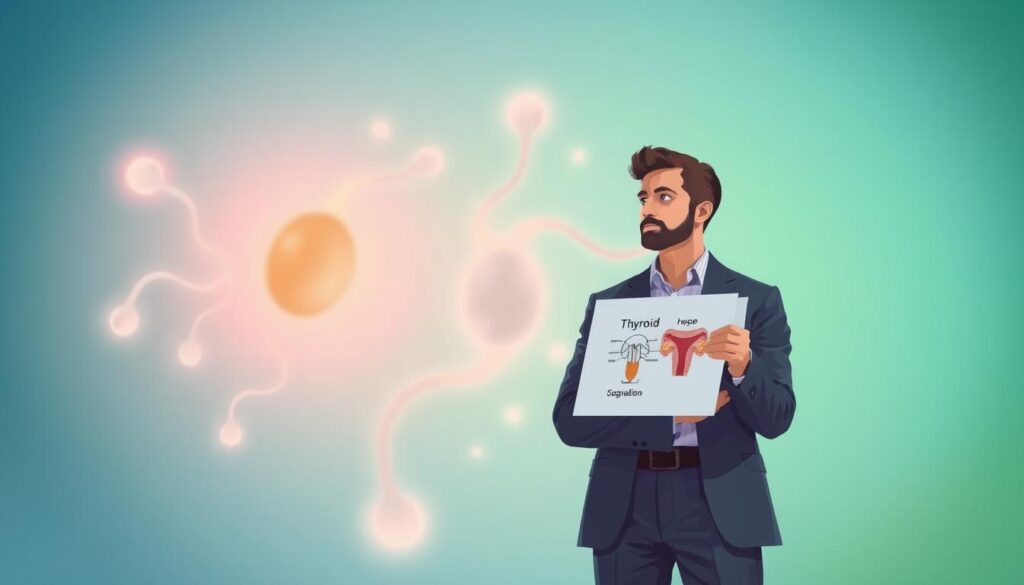
How thyroid dysfunction affects male reproductive physiology
Thyroid hormones bind to receptors in Sertoli and Leydig cells. They impact sperm production and sex hormone balance. Changes in these hormones can lower libido and affect semen quality.
Diagnosis and evidence linking thyroid disease to male infertility
Studies on male infertility and thyroid issues are less common. Yet, many clinical series show a link between thyroid problems and poor semen quality. Hyperthyroidism can lower sperm count, while hypothyroidism can affect motility and semen composition.
Management strategies for men
Men with thyroid disease should follow endocrinology advice. This includes levothyroxine for hypothyroidism and treatments for hyperthyroidism. Correcting thyroid levels can improve semen quality over time.
After thyroid levels are balanced, semen analysis should be repeated. This shows if there’s an improvement. If semen issues persist, a team of doctors can help. They may suggest fertility treatments.
Diagnosis, Treatment, and Fertility Management for People with Thyroid Disease
Having a clear plan is key to managing thyroid function and reproductive health. This is especially true when planning for pregnancy or surrogacy. Baseline testing, timely treatment, and regular monitoring help reduce risks and improve outcomes for all involved.

When to test thyroid function during fertility workup
Begin with TSH and free T4 tests if you’re planning to get pregnant or facing infertility. Add TPO antibody tests if there’s a family history of autoimmune diseases or if you’ve had recurrent miscarriages. It’s also important to check thyroid function before getting pregnant and again once you know you’re pregnant.
In pregnancy, repeat these tests in the first trimester and then as needed based on your initial results and any medication changes. If you’re doing IVF, consider testing before starting the cycle and discuss the need for repeat tests during the process.
Treatment recommendations to optimize fertility
If you have overt hypothyroidism, start taking levothyroxine and aim for a TSH level in the lower range. Many doctors aim for a TSH level around 1.5 to 2.0 mU/L.
For subclinical hypothyroidism, the decision to take levothyroxine depends on your TSH level and other factors. If you have hyperthyroidism, try to control it before getting pregnant. Use the lowest dose of antithyroid medication needed during pregnancy and follow your doctor’s advice on which medication to use.
Even if you have thyroid autoimmunity without abnormal test results, you might still need levothyroxine to improve your chances of a live birth. You may need to increase your levothyroxine dose during pregnancy. Your doctor will guide you on how much to take once you’re confirmed pregnant.
Implications for assisted reproductive technologies (ART)
Screening for thyroid function is crucial before starting ART. If your thyroid disease is not well-controlled, stabilize it before starting IVF, IUI, or ICSI. Hyperthyroidism usually means waiting until your thyroid levels are normal before starting ART.
Thyroid autoimmunity can increase the risk of miscarriage after IVF and may affect live birth rates. Talk to your fertility team about your individual risk. Some fertility treatments can affect your thyroid tests, so it’s important to monitor your levels during these cycles.
Practical steps patients can take
- Ask for baseline TSH and free T4 tests when planning to get pregnant or if you’re considering being a surrogate. Also, ask about TPO antibody testing if you have risk factors.
- If you’re taking levothyroxine, let your doctor know as soon as you find out you’re pregnant. Expect to increase your dose and have regular lab tests to monitor your levels.
- Take levothyroxine separately from iron, calcium, and antacids to improve absorption.
- Don’t stop taking antithyroid medication without your doctor’s advice. Discuss switching to PTU when trying to conceive and during the first trimester if recommended by your endocrinologist.
- Men with fertility concerns should include thyroid testing in their workup and repeat semen analysis after achieving normal thyroid levels.
- Share your thyroid history with fertility clinics, obstetricians, and surrogate coordinators to ensure coordinated monitoring.
- Seek multidisciplinary care when needed, including endocrinology, reproductive endocrinology, obstetrics, and maternal–fetal medicine for complex cases.
Additional Resources to read:
Can Acupuncture Treat Infertility
BMI Requirements for Surrogacy
Conclusion
Thyroid hormones (T3/T4) and TSH play a big role in reproductive health for both women and men. They affect ovulation, how the uterus gets ready for a fertilized egg, and sperm production. If your thyroid isn’t working right, it can make it harder to get pregnant and increase risks during pregnancy.
But, if you treat thyroid problems, things can get better. For those with subclinical hypothyroidism or thyroid autoimmunity, the effects on fertility are not always clear. It’s important for doctors to look at each case carefully, considering tests, symptoms, and what the patient wants.
Men shouldn’t be left out either. Thyroid issues can affect sperm quality, but treatment can often fix this. To improve fertility, it’s key to test TSH and free T4 levels first. Then, treat any thyroid problems and keep an eye on how treatments are working during pregnancy.
It’s also important to share your thyroid history with fertility teams. Working together with endocrinologists and fertility specialists can really help. This way, you can increase your chances of a successful pregnancy, whether you’re planning it yourself or supporting a surrogate.
Remember, you’re not alone in dealing with thyroid issues. They are common and can usually be managed. If you’re planning to get pregnant, facing infertility, or supporting a surrogate, don’t hesitate to ask for thyroid tests. If results show a problem, get help from an endocrinologist and make sure your fertility clinic knows about your thyroid health.
Good communication and a plan that fits you can make a big difference. It’s all about working together for the best possible outcome.
💫 Why Intended Parents Choose Complete Surrogacy for a Safe, Smooth & Successful Surrogacy Journey:
🌍 Access to multiple surrogacy destinations with 15+ years of international experience
🏥 Partnerships with top-tier fertility clinics and agencies, backed by references from past clients
👩🦱 Diverse egg donor options: Asian, Caucasian, African, Oriental, and more
💸 Transparent and affordable pricing—direct payments with no extra agency fees
🔒 No hidden costs—all charges are agreed upon upfront
🤝 Dedicated case manager for personalized support
📲 Fast, honest, and clear communication throughout
📑 Full legal support for visas, documentation, and baby exit processes
🚚 Assistance with frozen sperm/embryo shipment logistics
FAQ: How Thyroid Health Affects Fertility in Men & Women.
What is the thyroid and how does it affect fertility in men and women?
The thyroid is a gland at the base of the neck. It makes hormones that control metabolism. These hormones are important for the reproductive system in both men and women.
How does early pregnancy change thyroid physiology and why does that matter for conception and pregnancy?
Early pregnancy changes how the thyroid works. Human chorionic gonadotropin (hCG) makes TSH levels drop. This happens in the first trimester.
What are useful thyroid test reference points before and during pregnancy?
It’s important to use specific TSH reference ranges during pregnancy. These ranges vary by trimester and population. If these ranges aren’t available, a TSH level of about 4.0 mU/L is often used.
What is overt and subclinical hypothyroidism and how common are they in pregnancy?
Overt hypothyroidism means low free T4 and high TSH. Subclinical hypothyroidism has high TSH but normal free T4. In pregnancy, about 0.3–0.5% have overt hypothyroidism, and 2–5% have subclinical hypothyroidism.
How does hypothyroidism affect female fertility and ART outcomes?
Hypothyroidism can cause irregular periods and ovulation problems. It can also affect sperm quality and fertility. ART outcomes may vary, but controlling hypothyroidism is key.
How does hypothyroidism affect male fertility and ART outcomes?
Hypothyroidism can affect sperm quality and fertility. It can also impact sexual function. ART outcomes may vary, but controlling hypothyroidism is important.
What pregnancy risks are linked to untreated hypothyroidism?
Untreated hypothyroidism increases the risk of miscarriage and other pregnancy complications. It can also affect the baby’s health and development.
How is hypothyroidism managed to improve fertility and pregnancy outcomes?
Levothyroxine is the standard treatment for hypothyroidism. Before pregnancy, it’s important to optimize thyroid function. During pregnancy, thyroid hormone levels need to be closely monitored and adjusted.
What causes hyperthyroidism in reproductive-age people and how common is it in pregnancy?
Graves’ disease is the most common cause of hyperthyroidism in women. It affects about 0.4–1% of women before pregnancy and 0.2% during pregnancy. Temporary thyrotoxicosis is more common and usually occurs in the first trimester.
How does hyperthyroidism affect female fertility and pregnancy?
Hyperthyroidism can cause irregular periods and affect sex hormone balance. It can also impair ovulation and increase the risk of miscarriage and other pregnancy complications.
How is hyperthyroidism treated when pregnancy is planned or confirmed?
It’s important to control hyperthyroidism before pregnancy. During pregnancy, antithyroid drugs are used at the lowest effective dose. Propylthiouracil is often preferred in the first trimester.
What is thyroid autoimmunity (TAI) and how does it relate to unexplained infertility?
TAI is the presence of thyroid antibodies when thyroid function tests are normal. It can be linked to infertility and pregnancy complications. Treating TAI may improve fertility and pregnancy outcomes.

Author Bio: Neelam Chhagani is an International Surrogacy Expert with 15 years of experience in the fertility and surrogacy domain. As the founder of IVF Conceptions and Complete Surrogacy, she has guided over 4,000 intended parents worldwide on their surrogacy journey to parenthood. Recognized as a trusted authority, she specializes in holistic infertility solutions and third-party reproduction consulting.
Holding an MA in Counselling Psychology and a PGD in Mental Health, Neelam is a proud member of the European Fertility Society (EFS) and the European Society of Human Reproduction and Embryology (ESHRE). She is also a leading surrogacy blogger, providing valuable insights into ethical and practical surrogacy solutions.
Since 2010, committed to supporting ALL family types, Neelam has been passionate about helping intended parents grow their families with compassion, integrity, and a focus on secure and affordable surrogacy options Globally.
Learn more about Neelam:
https://www.ivfconceptions.com/neelam-chhagani-surrogacy-consultant/
https://www.linkedin.com/in/neelam-chhagani-92892229/













I was introduced to Neelam by a friend who worked with Neelam for surrogacy. Neelam is absolutely wonderful. I am a single male and the journey to fatherhood is not that easy. Neelam connected me to a program ideal for my circumstances. She was with me throughout the pregnancy providing advice and guidance along the way. I am so grateful I found her and am thrilled today that I have a beautiful daughter. I highly recommend Neelam to anyone who is on a journey to become a parent. Having a child has changed my world for the better. I wish others success with their own journey and recommend you connect with Neelam to find a path that is best for you.
SA (USA)