

Can hopeful Indian parents find a safer path to parenthood abroad? This is important now that India’s Surrogacy (Regulation) Act, 2021, and the Assisted Reproductive Technology (ART) Act have made options available at home.
This guide helps Indian citizens, including NRIs and OCI/PIO holders, navigate legal surrogacy abroad. Many turn to international options because of India’s strict rules. These include only allowing married heterosexual couples, banning commercial surrogacy, and requiring surrogates to be close relatives.
It’s a practical and caring guide. It offers a legal checklist, advice on conflict of laws, and a list of places like Georgia, Albania, Cyprus, the United Kingdom, and some U.S. states.
It also talks about the risks that worry parents. These include issues with parentage recognition, delays or refusals under Section 4 of the Indian Citizenship Act, 1955, and different embassy practices. The guide is supportive but also expert, encouraging ethical surrogacy and the protection of surrogate health and rights.
Key Takeaways
- India’s Surrogacy (Regulation) Act, 2021, narrows domestic options, prompting interest in overseas routes.
- Legal surrogacy for Indian citizens abroad requires careful preparation of documents and legal advice on conflict of laws.
- Destination rules differ widely; parentage orders and consular practices shape post‑birth outcomes.
- Early planning reduces risks of statelessness, citizenship delays, and travel complications.
- Prioritize ethical providers, licensed clinics, and qualified local attorneys in the destination country.
📞 Get in Touch for a Free Surrogacy Consultation
📱 +91-8800481100 (WhatsApp | LINE | Viber)
📧 neelam@ivfconceptions.com
Understanding the legal background in India and why families consider overseas surrogacy
The Surrogacy (Regulation) Act, 2021, and the Assisted Reproductive Technology (ART) Act set strict rules. They aim to stop the exploitation of women and control clinics. Clinics must register and follow detailed guidelines.
Overview of the Surrogacy (Regulation) Act, 2021, and Assisted Reproductive Technology (ART) Act
The Surrogacy Act bans commercial surrogacy, allowing only altruistic arrangements. A surrogate must be a close relative and get medical expenses covered, not paid. The ART Act requires IVF clinics to register and meet clinical standards.
Who is eligible for surrogacy in India, and who is excluded
Eligibility is strict. Only married heterosexual couples with at least five years of marriage and medical infertility can apply. Single people, LGBTQI+ individuals, most foreign nationals, NRIs, and OCIs are excluded. Widows and divorcees have limited, age-bound exceptions.
Why Indian citizens and NRIs look abroad: exclusions, altruistic-only rule, and practical barriers
Families seek abroad options due to the altruistic-only rule and the close-relative requirement. Many countries allow compensated surrogacy or gestational arrangements with unrelated surrogates. Overseas clinics offer broader access for those excluded at home.
Key legal risks posed by India’s restrictive framework: parentage, citizenship, and documentary gaps
Parentage can be uncertain with foreign birth or parentage orders conflicting with laws. Indian consulates check if intended parents are legally recognized before issuing documents. This affects passports and travel papers.
Citizenship is another risk. A child born abroad to Indian parents may get citizenship by descent. But, proving legal parentage can be challenging.
Documentary gaps cause delays. Missions often ask for surrogacy contracts, ART clinic records, birth certificates, and sometimes DNA results. Practices vary, leading to unpredictable timelines for families.
The legal landscape is complex. Advocates and fertility specialists push for reform. They aim for fair access to parenthood while protecting against exploitation.
How Indian Citizens Can Legally Pursue Surrogacy Overseas
Before you travel and get treatment, it’s important to do a legal review. This step helps avoid delays when the baby is born and when you apply for travel documents. Here’s a checklist to guide you through the legal steps for international surrogacy and the process for Indians.
Initial legal checklist for intending parents
- Check if you’ll be recognized as a parent in India after returning (citizenship by descent and passport rules).
- Find an Indian lawyer who knows about cross-border family law and a local lawyer in your destination.
- Make sure the clinic is licensed and the agency is checked; confirm if commercial surrogacy is allowed in your destination.
- Plan your budget for medical care, legal fees, embassy charges, travel, and insurance for the surrogate.
- Have a plan for failed transfers, maternal complications, and possible non-recognition of parentage.
Understanding conflict of laws
Parentage laws vary by country. Some states use a genetic-link test. Others apply the intended-parent doctrine or issue pre-birth orders. These differences can cause issues when Indian consular posts review your documents.
Pre-birth orders are very important. They allow intended parents to be listed on the birth certificate right away. In places that require a genetic link, you might need DNA testing and a court process after birth.
Indian embassies and the FRRO need proof that you’re the legal parents under the birth state’s law. This is key for the international surrogacy process for Indians and highlights the legal aspects of surrogacy abroad.
Essential documents to prepare in advance
- Valid passports for both intended parents and several notarized copies.
- Marriage certificate and proof of any required minimum marriage duration.
- Medical records that show infertility or medical need (IVF records, uterine agenesis, MRKH diagnosis).
- ART clinic files: embryo transfer notes, pregnancy reports, and prenatal records.
- Surrogacy agreement, noting if commercial surrogacy is allowed in your destination.
- Any court orders (pre-birth parentage orders or post-birth confirmations) and notarized powers of attorney for hospital processes.
- Police clearances, identity proofs, and proof of funds or insurance for surrogate care.
Role of surrogacy contracts and court orders
Contracts show your intent and who is responsible. Authorities use them to check parentage claims and citizenship requests. A good agreement covers all the documents you’ll need for both the birth state and Indian consular practice.
Pre-birth court orders are very valuable where allowed. They secure your status as parents before the baby is born. If you can’t get a pre-birth order, plan to go to court quickly after the baby is born. This avoids delays in travel documents and citizenship applications.
With careful planning, clear documents, and legal advice in both places, you can reduce risks. These steps help you navigate the legal aspects of surrogacy abroad and align with the international surrogacy process for Indians.
Choosing a destination: comparison of overseas surrogacy options and legal requirements

When choosing a place for surrogacy abroad, it’s important to look at local laws, medical care, and how consulates handle things. You need to think about the legal process, cost, clinic quality, and how easy it is to get travel documents after the baby is born.
Legal rules vary a lot. Some places let you pay for surrogacy and have clear rules for becoming a parent. Others require a genetic link between the parent and the child. Many European countries only allow surrogacy for free, making it hard for people from other countries.
Countries historically favoured by Indian nationals and NRIs: overview of legal models
Indian people have looked at different places for surrogacy, from areas that allow it to places that don’t. Each place has its own rules for getting parentage, birth records, and travel documents.
Georgia: legal clarity, court orders, and consular cooperation
Georgia was popular because courts gave parentage orders and birth certificates with the parents’ names. This made it easier to deal with Indian missions and get citizenship faster.
But new rules have made commercial surrogacy harder. Intended parents need to check the latest laws and what the Indian Embassy in Tbilisi says before they start.
Albania and Cyprus: genetic-link requirements and DNA considerations
Albania lets you pay for surrogacy, but usually needs a genetic link. Cyprus also needs a genetic link and uses DNA tests to confirm parentage.
This means you need to plan carefully. You’ll need to find a fertility clinic, make a contract, and get DNA results on time for the consulate to accept them.
United Kingdom: altruistic model, parental orders, and residence restrictions
The UK only allows surrogacy for free. Surrogacy agreements aren’t automatically legal. Intended parents must apply for a parental order after the baby is born to be legally recognized.
Nonresidents face extra challenges if they don’t have strong ties to the UK. The process can be slow and uncertain because of strict rules for surrogates.
Other places are also worth considering. Some US states, such as California, offer strong legal protection and pre-birth orders, but these options can be expensive. Legal rules change, so it’s important to keep up with new laws and policies.
Key things to think about include:
- Whether you can get a parentage order before or after the baby is born.
- How embassies handle birth certificates and DNA evidence.
- Genetic-link mandates that trigger mandatory testing.
- Medical standards, cost, and surrogate protections (insurance and consent).
- Predictability of exit formalities and Indian citizenship recognition.
| Jurisdiction Type | Example Countries | Key Legal Feature | Practical Notes for Indian Parents |
|---|---|---|---|
| Commercial-permissive | Georgia (historical), California (selected US states) | Compensation allowed; clear parentage orders often available | Usually faster parentage recognition; verify current overseas surrogacy regulations and embassy practice |
| Genetic-link required | Albania, Cyprus | At least one commissioning parent must be genetic; DNA testing common | Prepare genetic documentation in advance; expect consular DNA checks under indian citizen surrogacy regulations |
| Altruistic, restrictive | United Kingdom | No commercial surrogacy; parental orders after birth; surrogate rights emphasized | Longer timelines for parental orders; residency or eligibility limits can affect access |
| Highly regulated/prohibitive | Netherlands, Germany | Commercial surrogacy prohibited or legally problematic | Recognition is difficult; not recommended for international arrangements under overseas surrogacy options |
Practical legal steps after birth: establishing parentage, citizenship, travel documents, and avoiding statelessness

After a child is born overseas, it’s important to act quickly. You need to get a clear birth certificate or parentage order that names you as the legal parents. Make sure to follow the host country’s court or registry procedures closely.
How to obtain foreign parentage orders or birth certificates that name the intended parents
If pre-birth orders are available, get them before delivery. This way, the birth record will list both parents’ names and passport details. If local law requires post-birth proceedings, hire a local family law attorney to file for parental orders fast.
Applying for Indian citizenship by descent: required evidence, surrogacy agreements, and consular scrutiny
A child born abroad to an Indian citizen can get citizenship by descent. Indian consulates need the foreign birth certificate, surrogacy agreement, ART clinic records, and court orders. They also ask for parents’ passports and marriage certificate. Having strong documentary proof helps speed up the process.
DNA testing, embassy practices, and variation between Indian missions
Embassy and consulate requirements can vary. Some focus on paperwork, while others require DNA testing. Be prepared for notarized translations, apostilles, and clinic certifications. Keep detailed records to avoid extra requests.
Exit procedures and immigration formalities (FRRO, visas, OCI/PIO issues for children born abroad)
Plan exit procedures early. Authorities and some missions may ask for prior permissions or records. For children eligible for Indian citizenship, apply for consular acceptance of citizenship by descent. Then, apply for an Indian passport. If citizenship is delayed, get an interim travel document from the host country to avoid statelessness.
When an Indian resident commissions surrogacy abroad, follow the guidelines for overseas surrogacy. Work with legal counsel to coordinate the necessary documents. This ensures the child has at least one nationality and meets the legal requirements for overseas surrogacy.
Additional Resources to Read:
How Much Does Surrogacy Cost in India?
Is Surrogacy Legal in India for Foreigners
Is Surrogacy Legal in India for Foreigners
Conclusion
The Surrogacy (Regulation) Act, 2021, and the ART Act have made it harder for families to find surrogacy at home. Many are now looking abroad. For Indians, this means choosing between options at home and international ones, while understanding the legal issues.
Before you start, make a legal plan. Get advice from experts in the country you choose and in India. You’ll need passports, marriage certificates, medical records, and strong surrogacy contracts. Also, prepare for court orders, DNA tests, and exit procedures.
Always think about the surrogate’s well-being. Choose licensed clinics and clear contracts. Make sure the surrogate knows what they’re agreeing to and is treated fairly. This way, you respect the surrogate and follow the rules of international surrogacy.
Going abroad for surrogacy is complex. Talk to family law experts, a good fertility clinic, and the Indian consulate early. If done right, it can lead to parenthood while handling legal and practical challenges.
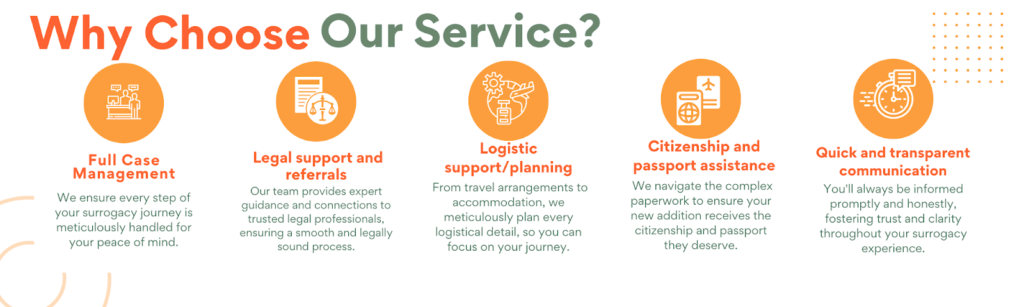
💫 Why Intended Parents Choose Complete Surrogacy for a Safe, Smooth & Successful Surrogacy Journey:
🌍 Access to multiple surrogacy destinations with 15+ years of international experience
🏥 Partnerships with top-tier fertility clinics and agencies, backed by references from past clients
👩🦱 Diverse egg donor options: Asian, Caucasian, African, Oriental, and more
💸 Transparent and affordable pricing—direct payments with no extra agency fees
🔒 No hidden costs—all charges are agreed upon upfront
🤝 Dedicated case manager for personalized support
📲 Fast, honest, and clear communication throughout
📑 Full legal support for visas, documentation, and baby exit processes
🚚 Assistance with frozen sperm/embryo shipment logistics
FAQ-How Indian Citizens Can Legally Pursue Surrogacy Overseas
What is the scope of this guide — who is it for and what does it cover?
This guide is for Indian citizens, including NRIs and those with OCI/PIO status, who want to explore surrogacy abroad. It covers the legal steps involved, from the initial checklist to post-birth procedures. It also talks about the importance of ethical practices and the rights of surrogates.
Why do many Indian citizens consider overseas surrogacy?
The Surrogacy (Regulation) Act, 2021, in India limits options for surrogacy. It bans commercial surrogacy and only allows altruistic surrogacy with close relatives. Many people, including single individuals and LGBTQI+ individuals, are excluded. This pushes them to look for options abroad.
What are the central legal risks for Indian citizens pursuing surrogacy abroad?
The main risks include uncertainty about parentage and delays in citizenship. Indian authorities might not automatically recognize foreign parentage orders. This can lead to demands for DNA testing, longer processing times, or refusal of citizenship applications.
What should be on an initial legal checklist before choosing a destination country?
First, check if the destination country is recognized by India for citizenship by descent. Consult with an Indian lawyer and a local lawyer in the destination country. Verify the surrogacy and parentage rules in the destination country. Choose licensed ART clinics and budget for all expenses. Prepare for unexpected situations.
How do conflict‑of‑laws issues affect parentage and recognition in India?
Parentage is determined by the law of the country where the child is born. Different countries have different rules. Indian consular recognition is not guaranteed and depends on the birth state’s laws. Pre-birth orders can make the process easier, but DNA testing may be required in some cases.
What essential documents must intending parents prepare in advance?
You’ll need valid passports and copies, marriage certificates, and medical records. Also, prepare the surrogacy agreement, any court orders, powers of attorney, police clearances, and proof of funding. Legalisation and certified translations may be needed.
What role do surrogacy contracts and pre‑birth court orders play in establishing parentage?
A well-drafted surrogacy contract is key evidence for courts and consulates. Pre-birth court orders can name intended parents on the birth certificate. If not available, start court proceedings quickly after birth to avoid delays.
How do different destination legal models affect Indian intended parents?
Legal models vary widely. Some countries allow commercial surrogacy and have clear parentage pathways. Others require genetic links or altruistic arrangements. Each model affects the documentation, cost, and timing of the process.
What should intending parents know about Georgia as a destination?
Georgia was once popular for its clear parentage procedures and consular cooperation. Legal reforms are changing, so check current laws and embassy practices before proceeding.
What are the legal features of Albania and Cyprus relevant to surrogacy?
Albania and Cyprus allow surrogacy with a genetic link requirement. DNA testing is common. Ensure you have thorough ART records and birth certificates for smooth consular processing.
How does the United Kingdom’s surrogacy model affect non‑resident intended parents?
The UK only allows altruistic surrogacy. Intended parents must apply for a parental order after birth. This process can take months and requires careful planning.
How can intended parents obtain foreign parentage orders or birth certificates that name them?
Follow the destination’s family law procedures closely. Secure pre-birth orders if available. If not, start court proceedings quickly after birth. Ensure the birth certificate clearly names the intended parents.
How does Indian citizenship by descent (Section 4) work for children born abroad via surrogacy?
A child born abroad to an Indian citizen may be eligible for citizenship by descent. Consular acceptance depends on documentary proof. Indian consulates often request specific documents and may ask for DNA tests.
Will Indian embassies always require DNA testing for surrogacy cases?
No. Embassy practices vary. Some missions may accept documentary evidence without DNA testing. Others may require DNA testing. Plan for possible DNA testing and extra verification steps.
What are the exit formalities and immigration issues to plan for after a foreign surrogacy birth?
Coordinate local parentage proceedings and birth registration. Then apply for the child’s travel document and Indian citizenship. If citizenship is delayed, obtain local travel documents. Follow FRRO checks and documentation for return to India.
How can parents avoid statelessness for a child born via surrogacy abroad?
Secure the host-country birth certificate and legal parentage quickly. Ensure at least one intended parent’s nationality is substantiated for citizenship by descent in India. Use legal counsel to synchronize host-country parentage recognition with Indian consular requirements.
What ethical and practical standards should intending parents follow when pursuing surrogacy overseas?
Prioritize the surrogate’s health, informed consent, and legal protections. Use licensed clinics and draft transparent contracts. Ensure surrogate insurance and medical care. Avoid exploitative arrangements and engage experienced legal counsel.
Who should intending parents consult before starting an overseas surrogacy plan?
Consult a specialist Indian lawyer, a reputable fertility clinic, and a qualified local family law attorney. Contact the relevant Indian consulate early for documentary expectations. Coordinated advice reduces risks and ensures prompt parentage recognition and citizenship processing.

Author Bio: Neelam Chhagani is an International Surrogacy Expert with 15 years of experience in the fertility and surrogacy domain. As the founder of IVF Conceptions and Complete Surrogacy, she has guided over 4,000 intended parents worldwide on their surrogacy journey to parenthood. Recognized as a trusted authority, she specializes in holistic infertility solutions and third-party reproduction consulting.
Holding an MA in Counselling Psychology and a PGD in Mental Health, Neelam is a proud member of the European Fertility Society (EFS) and the European Society of Human Reproduction and Embryology (ESHRE). She is also a leading surrogacy blogger, providing valuable insights into ethical and practical surrogacy solutions.
Since 2010, committed to supporting ALL family types, Neelam has been passionate about helping intended parents grow their families with compassion, integrity, and a focus on secure and affordable surrogacy options Globally.
Learn more about Neelam:
https://www.ivfconceptions.com/neelam-chhagani-surrogacy-consultant/
https://www.linkedin.com/in/neelam-chhagani-92892229/















I was introduced to Neelam by a friend who worked with Neelam for surrogacy. Neelam is absolutely wonderful. I am a single male and the journey to fatherhood is not that easy. Neelam connected me to a program ideal for my circumstances. She was with me throughout the pregnancy providing advice and guidance along the way. I am so grateful I found her and am thrilled today that I have a beautiful daughter. I highly recommend Neelam to anyone who is on a journey to become a parent. Having a child has changed my world for the better. I wish others success with their own journey and recommend you connect with Neelam to find a path that is best for you.
SA (USA)