

Choosing the right U.S. state for surrogacy is a critical decision for intended parents. Surrogacy laws vary by state—some offer full legal protection and streamlined processes, while others restrict or even prohibit certain arrangements.
In this article, we compare the best states for surrogacy in the USA based on legality, parentage orders, cost, LGBTQ+ inclusion, and medical infrastructure.
Did you know that over 60% of intended parents encounter legal roadblocks during surrogacy due to inconsistent state laws? The U.S. has no federal surrogacy legislation, creating a patchwork of regulations that directly impact outcomes. Choosing where to pursue this path isn’t just about clinics or costs—it’s about legal security.
Surrogacy journeys thrive in regions with clear, supportive laws. For example, gestational surrogacy (where the surrogate has no genetic link) is widely accepted, but traditional surrogacy faces restrictions in many areas. Some states even require pre-birth parentage orders to ensure legal recognition of intended parents.
Why does location matter so much? Laws determine eligibility requirements, compensation rules, and post-birth processes. A few states have “surrogacy-friendly” frameworks with streamlined court procedures and enforceable contracts. Others lack specific guidelines, leaving families vulnerable to delays or disputes.
Top 5 Best States for Surrogacy in the USA
| State | Surrogacy-Friendly Laws | Pre-Birth Order | LGBTQ+ Access | Avg Cost (USD) | Special Notes |
|---|---|---|---|---|---|
| California | ✅ Commercial surrogacy legal | ✅ Available | ✅ Yes | $130,000 – $180,000 | Most surrogacy-friendly, strong legal support |
| Illinois | ✅ Commercial surrogacy is legal | ✅ Available | ✅ Yes | $110,000 – $150,000 | Clear statutes, simplified legal steps |
| Nevada | ✅ Commercial surrogacy is legal | ✅ Available | ✅ Yes | $100,000 – $140,000 | Lower costs, inclusive laws |
| Connecticut | ✅ Commercial surrogacy is legal | ✅ Available | ✅ Yes | $120,000 – $160,000 | Smooth legal parentage process |
| Oregon | ✅ Commercial surrogacy is legal | ✅ Available | ✅ Yes | $110,000 – $150,000 | No residency requirement for IPs |
Key Takeaways
- Surrogacy legality varies dramatically across U.S. states
- Gestational arrangements are more widely protected than traditional surrogacy
- Early legal planning prevents complications during the process
- Certain states offer pre-birth orders and clear contract enforcement
- This guide clarifies how to evaluate locations for optimal outcomes
📞 Get in Touch for a Free Surrogacy Consultation
📱 +91-8800481100 (WhatsApp | LINE | Viber)
📧 neelam@ivfconceptions.com

Understanding the Surrogacy Landscape in the United States
Modern surrogacy arrangements fall into two distinct categories, each carrying unique legal implications. Gestational surrogacy involves a carrier who has no genetic connection to the child, while traditional surrogacy uses the surrogate’s egg. These differences shape everything from medical protocols to court procedures.
Gestational vs. Traditional: A Legal Crossroads
Gestational agreements now dominate U.S. surrogacy journeys due to clearer legal protections for intended parents. States like California enforce ironclad contracts through rulings like the 1993 Johnson v. Calvert case, which established genetic parents’ rights over traditional surrogates. Traditional arrangements face more restrictions, with some locations requiring adoption processes even after birth.
How Precedent Shapes Parental Rights
Surrogacy in Illinois pioneered modern frameworks with its 2005 Gestational Surrogacy Act, allowing pre-birth orders that streamline parental recognition. Contrast this with states like Louisiana, where only married heterosexual couples can pursue compensated surrogacy. Recent updates in Washington (2018) and New York (2021) show how evolving surrogacy laws reflect changing societal norms.
Legal clarity directly impacts intended parents’ security. In surrogacy-friendly jurisdictions, courts honor contracts signed before pregnancy. Less accommodating areas may force parents through lengthy custody battles, even when using their embryos. This patchwork system underscores why location planning remains critical.
Key Elements of a Surrogacy-Friendly State
The foundation of a secure surrogacy journey lies in robust legal protections. Jurisdictions with established frameworks minimize risks through enforceable agreements and court-backed safeguards. Two pillars stand out: pre-birth orders and meticulously drafted contracts.
Pre-Birth Orders and Legal Parentage
Pre-birth orders grant intended parents legal recognition before delivery, bypassing post-birth custody battles. States like California allow these orders as early as the second trimester. Illinois codified this process in 2005, enabling families to list their names directly on birth certificates.
Without pre-birth orders, parents might face adoption proceedings even with genetic ties to the child. This legal tool streamlines the process, reducing stress for all parties. Courts in supportive regions prioritize these cases, often resolving them within weeks.
Surrogacy Contracts and Enforceability
Well-structured Surrogacy contracts outline responsibilities, compensation, and medical decisions. They serve as binding agreements under law when drafted by specialists. A 2019 California ruling upheld a contract requiring surrogates to follow specific prenatal care protocols.
Enforceability varies by location. Surrogacy-friendly states treat these documents as irrevocable once signed. Others may challenge terms related to embryo disposition or pregnancy termination. Working with attorneys familiar with local precedent ensures compliance.
Key steps in the legal process include:
- Contract negotiations covering all possible scenarios
- Medical and psychological screenings for both parties
- Court filings for pre-birth orders
Reputable Surrogacy agencies and experienced lawyers bridge gaps between medical plans and legal realities. Their expertise turns complex statutes into actionable roadmaps for families.
Why Surrogacy Laws Vary by State
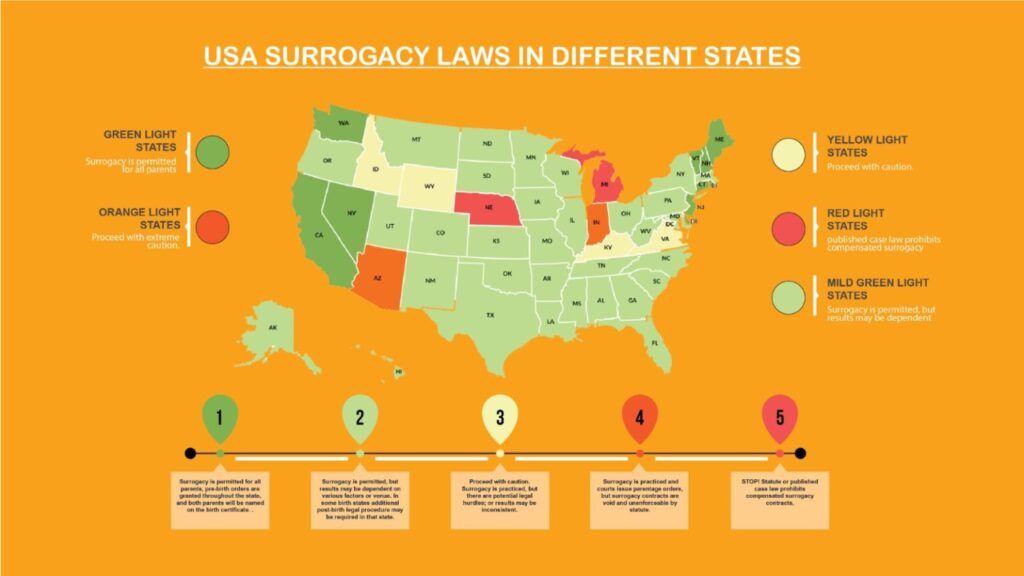
Surrogacy is governed at the state level in the U.S., not federally. This means laws, protections, and procedures differ depending on the location. Some states offer statutory support, making them ideal for both domestic and international intended parents.
States like California and Illinois have codified laws supporting surrogacy, offering parentage rights, enforceable contracts, and protection for all parties.
🏳️🌈 Best States for LGBTQ+ Surrogacy
Inclusive surrogacy laws are crucial for same-sex couples and LGBTQ+ singles. The following states are particularly welcoming:
- California – Recognized globally for LGBTQ+ rights in surrogacy.
- Connecticut – Allows parentage for all family types.
- Oregon – Inclusive laws and progressive courts.
- New Jersey – Recently updated surrogacy laws favor LGBTQ+ families.
Examining State-Specific Surrogacy Laws and Practices
Legal frameworks for surrogacy vary significantly across jurisdictions, creating distinct experiences for families and carriers. Four regions demonstrate how localized statutes influence outcomes:
Insights from California, Illinois, Washington, and Florida
California’s Family Code Section 7960 sets the gold standard, allowing pre-birth orders for all family types. Courts here issue birth certificates listing intended parents without requiring genetic ties. A 2022 case involving same-sex partners affirmed this inclusive approach.
Illinois streamlines processes through its Gestational Surrogacy Act. Compensation agreements gain legal protection once medical screenings conclude. The state’s surrogacy legal framework also permits same-day court approvals for parentage orders.
Washington’s 2019 Uniform Parentage Act introduced novel safeguards. Surrogates retain healthcare decision rights while intended parents cover medical costs. Unlike California, compensation here cannot exceed reasonable living expenses.
Florida operates under stricter rules (Statute §63.213). Only married couples qualify for gestational agreements, and traditional surrogacy remains prohibited. Recent cases show courts occasionally challenge contracts lacking precise medical protocols.
These differences highlight why location impacts security and efficiency. States with decades of experience typically resolve disputes faster, while newer frameworks may involve untested procedures. Legal specialists recommend prioritizing regions with established case law and clear compensation guidelines.
Navigating Legal Challenges in the Surrogacy Process
Surrogacy’s legal maze demands expert navigation to protect everyone involved. Even with thorough preparation, unexpected roadblocks can arise—from contested contracts to custody disputes. This is where seasoned legal professionals become indispensable allies.
The Role of Experienced Surrogacy Attorneys
Specialized attorneys do more than draft contracts—they anticipate issues before they escalate. Members of groups like the American Academy of Assisted Reproductive Technology Attorneys (AAARTA) understand how local courts interpret surrogacy agreements. For example, they might secure pre-birth orders in states requiring genetic proof for parentage claims.
Independent counsel ensures both surrogates and intended parents understand their rights. A 2023 case in Nevada highlighted this when a surrogate’s lawyer identified unenforceable terms about medical decisions. Revised contracts prevented a potential court battle post-delivery.
Common challenges attorneys resolve include:
- Interstate complications when surrogates live in different regions
- Enforcing compensation terms if pregnancies end early
- Updating birth certificates when using donor embryos
Working with experts remains the safest way to navigate this evolving field. As one AAARTA member notes: “Proper legal frameworks turn hopeful plans into secure realities.” Their guidance transforms complex statutes into clear pathways for growing families.
Comparing Costs, Compensation, and Procedures Across States
Financial planning for surrogacy requires understanding how location shapes expenses. Compensation for surrogates ranges from $30,000 to $70,000 nationally, but state-specific rules create stark contrasts. Florida caps base compensation at $35,000, while Washington allows higher amounts tied to living costs.
Insurance coverage also varies. Some states mandate policies covering surrogacy-related medical risks, while others leave this to intended parents. Reputable surrogacy agencies often negotiate group insurance plans, reducing out-of-pocket costs by up to 40% in regulated markets.
Surrogacy Cost Comparison by State
| State | Estimated Total Cost (USD) | Factors Affecting Cost |
|---|---|---|
| California | $130,000 – $180,000 | High surrogate compensation, top clinics, legal fees |
| Illinois | $110,000 – $150,000 | Balanced costs with strong legal clarity |
| Nevada | $100,000 – $140,000 | Affordable surrogacy with solid legal framework |
| Georgia | $95,000 – $135,000 | Limited legal protections for LGBTQ+ intended parents |
| Florida | $110,000 – $145,000 | Favorable laws, growing surrogacy programs |
Clear agreements prevent budget surprises. Legal fees alone can differ by $15,000 between states—Florida requires dual attorney reviews, increasing costs. Medical screenings and embryo transfers add another layer of location-based pricing. One agency director notes: “Transparent contracts turn unpredictable expenses into manageable line items.”
Hidden costs often include:
- Travel for medical appointments in states with limited fertility clinics
- Psychological support requirements in certain jurisdictions
- Post-birth legal filings if crossing state lines
Smart financial planning starts with comparing surrogacy processes regionally. Budget 10-15% extra for unexpected steps in this deeply personal journey. Partnering with experienced professionals helps intended parents allocate resources effectively while prioritizing everyone’s well-being.
Best state for surrogacy in the USA: Legal and Practical Considerations
A 2023 Surrogacy in Oregon case demonstrated how location shapes outcomes when intended parents secured custody within 48 hours of birth. Such efficiency stems from specific legal frameworks that prioritize family creation while protecting all parties involved.
Regional Legal Frameworks and Outcomes
Surrogacy in California leads with its pre-birth order system, enabling seamless birth certificate updates for non-genetic parents. New York’s 2021 Child-Parent Security Act reversed its surrogacy ban, now requiring comprehensive health insurance for carriers. Oregon stands out by permitting single individuals and LGBTQ+ couples to pursue compensated agreements without genetic linkage requirements.
Contrast this with states lacking clear statutes, where custody battles can delay parent-child bonding for months. Legal stability directly affects matching processes—agencies in regulated regions complete pairings 30% faster, according to 2022 industry data.
What to Look for in a Surrogacy-Friendly State
When choosing the best state, consider the following factors:
- ✅ Clear surrogacy laws
- ✅ Enforceable contracts
- ✅ Pre-birth or post-birth orders
- ✅ Support for LGBTQ+ and single parents
- ✅ Proven court precedents
- ✅ Experienced surrogacy professionals and clinics
International Intended Parents: Best U.S. States
For international intended parents, the top states are:
These states issue pre-birth orders and recognize non-resident parents, making travel, birth certificate issuance, and passport processing smoother.
Quick Checklist: Choosing the Right State
| ✅ Factor | 📌 Consideration |
|---|---|
| Legal Clarity | Prefer states with explicit surrogacy legislation |
| Parental Rights | Ensure pre-birth or post-birth orders are available |
| Surrogate Compensation Limits | Some states limit or restrict paid surrogacy |
| LGBTQ+ Access | Inclusive legal protection is key |
| Cost Management | Look at agency, legal, and medical costs by region |
Additional Resources to read:
Is Surrogacy Legal in Georgia Country
Updated Surrogacy Laws in India
Conclusion
While many U.S. states offer surrogacy options, California, Illinois, and Connecticut consistently rank among the best due to legal clarity, inclusive policies, and streamlined parentage procedures.
For LGBTQ+ families and international intended parents, these states provide the most secure and predictable pathways to parenthood.
Why Intended Parents Choose Complete Surrogacy for a Safe, Smooth & Successful Surrogacy Journey:
🌍 Access to multiple surrogacy destinations with 15+ years of international experience
🏥 Partnerships with top-tier fertility clinics and agencies, backed by references from past clients
👩🦱 Diverse egg donor options: Asian, Caucasian, African, Oriental, and more
💸 Transparent and affordable pricing—direct payments with no extra agency fees
🔒 No hidden costs—all charges are agreed upon upfront
🤝 Dedicated case manager for personalized support
📲 Fast, honest, and clear communication throughout
📑 Full legal support for visas, documentation, and baby exit processes
🚚 Assistance with frozen sperm/embryo shipment logistics

Author Bio: Neelam Chhagani is an International Surrogacy Expert with 15 years of experience in the fertility and surrogacy domain. As the founder of IVF Conceptions and Complete Surrogacy, she has guided over 4,000 intended parents worldwide on their surrogacy journey to parenthood. Recognized as a trusted authority, she specializes in holistic infertility solutions and third-party reproduction consulting.
Holding an MA in Counselling Psychology and a PGD in Mental Health, Neelam is a proud member of the European Fertility Society (EFS) and the European Society of Human Reproduction and Embryology (ESHRE). She is also a leading surrogacy blogger, providing valuable insights into ethical and practical surrogacy solutions.
Since 2010, committed to supporting ALL family types, Neelam has been passionate about helping intended parents grow their families with compassion, integrity, and a focus on secure and affordable surrogacy options Globally.
Learn more about Neelam:
https://www.ivfconceptions.com/neelam-chhagani-surrogacy-consultant/
https://www.linkedin.com/in/neelam-chhagani-92892229/















I was introduced to Neelam by a friend who worked with Neelam for surrogacy. Neelam is absolutely wonderful. I am a single male and the journey to fatherhood is not that easy. Neelam connected me to a program ideal for my circumstances. She was with me throughout the pregnancy providing advice and guidance along the way. I am so grateful I found her and am thrilled today that I have a beautiful daughter. I highly recommend Neelam to anyone who is on a journey to become a parent. Having a child has changed my world for the better. I wish others success with their own journey and recommend you connect with Neelam to find a path that is best for you.
SA (USA)